A geography of risk that transcends borders
From Madrid to Buenos Aires, Lisbon to Santiago de Chile, Rome to São Paulo and Barcelona to Bogotá, contemporary societies face a profound transformation of their security, economic, climatic and technological environment.
Crises no longer recognise borders. A drought can undermine agricultural production, drive up food prices, disrupt trade and intensify social tensions. A cyberattack on an energy operator can simultaneously affect telecommunications, transport, healthcare facilities and public services.
These phenomena illustrate a fundamental shift: we no longer face only isolated risks, but interdependent risks capable of triggering domino effects on an international scale.
Through their work, the Intergovernmental Panel on Climate Change (IPCC), the United Nations Office for Disaster Risk Reduction (UNDRR) and the European Commission’s Joint Research Centre (JRC) emphasise the importance of an integrated approach to vulnerabilities, anticipation and resilience.
For Southern Europe and Latin America, this approach is a strategic necessity, as well as a tremendous opportunity for scientific, industrial and institutional cooperation.
1. Climate change: shared vulnerabilities from the Mediterranean to the Andes
The Mediterranean basin is one of the regions particularly exposed to global warming. Research by the IPCC and the MedECC scientific network highlights growing risks associated with heatwaves, drought, wildfires, extreme precipitation and dwindling water resources.
In Spain, the catastrophic floods in the Valencia region in October 2024 were a reminder of the vulnerability of densely urbanised areas to extreme weather events.
In Portugal, Greece and Italy, wildfires, droughts and periods of intense heat raise major questions for civil protection, forest management, public health and economic continuity.
On the other side of the Atlantic, the same questions arise in different forms.
In 2024, floods in the Brazilian state of Rio Grande do Sul caused mass population displacement and considerable disruption to infrastructure, economic activity and essential services.
In Chile, the combination of drought, high temperatures and wildfires threatens communities and their surroundings. In the Andes, changes in glaciers are gradually altering the outlook for water availability for certain communities, agricultural activities and hydroelectric facilities.
These crises raise several scientific and operational questions:
- How can artificial intelligence and satellite data improve the forecasting of extreme climate events?
- How can the economic and social consequences of disasters be modelled?
- How can infrastructure be designed to withstand increasingly complex events?
- How can coordination among scientists, public authorities, insurers and industry be strengthened?
Organisations such as Spain’s Agencia Estatal de Meteorología (AEMET), Brazil’s Centro Nacional de Monitoramento e Alertas de Desastres Naturais (CEMADEN), Chile’s Centro de Ciencia del Clima y la Resiliencia (CR2) and the European Centre for Medium-Range Weather Forecasts (ECMWF) develop knowledge and tools essential to this transformation.
The challenge is no longer simply to forecast a disaster, but to anticipate its cascading consequences, protect populations and accelerate the return to a situation under control.
2. Earthquakes, volcanoes and coastal risks: learning from Latin American experience
Chile, Mexico, Peru, Colombia and several Central American countries have considerable experience with seismic and volcanic risks.
The magnitude 8.8 earthquake that struck Chile on 27 February 2010 is a major case study for researchers and infrastructure resilience specialists.
The seismic monitoring arrangements, warning systems, building standards and preparedness exercises developed in these countries are of direct interest to Southern Europe.
Italy, Greece, Portugal and Spain are themselves exposed, to varying degrees, to seismic, volcanic or tsunami risks.
The work of Mexico’s Servicio Sismológico Nacional, Chile’s Centro Sismológico Nacional, Italy’s Istituto Nazionale di Geofisica e Vulcanologia (INGV) and European geophysical monitoring organisations offers significant prospects for cooperation.
Beyond geographical differences, a shared question emerges: how can scientific knowledge of natural hazards be translated into public decisions, preventive investment and operational crisis management capabilities?
3. Cybersecurity, disinformation and critical infrastructure: a transatlantic threat
Digital transformation is bringing European and Latin American economies closer together, while also multiplying their points of exposure to cyber threats.
Electricity grids, hospitals, ports, airports, banks, public administrations and industrial facilities depend on interconnected digital systems.
A cyberattack can now become an economic, health, industrial or territorial crisis.
Ransomware attacks, intrusions into industrial systems, supplier compromises and disinformation campaigns illustrate this convergence.
Spain has, among other bodies, the Instituto Nacional de Ciberseguridad (INCIBE) and the Centro Criptológico Nacional (CCN), while the European Union relies on ENISA and a strengthened regulatory framework, particularly through the NIS2 Directive and the DORA Regulation.
In Latin America, organisations such as the Organization of American States (OAS), alongside national incident response centres, contribute to the development of cybersecurity capabilities.
Scientific cooperation could focus in particular on:
- Artificial intelligence applied to cyber threat detection.
- The protection of industrial systems and critical infrastructure.
- Combating disinformation and information manipulation.
- The resilience of digital supply chains.
- Simulation exercises for cross-border cyber crises.
Cybersecurity is no longer exclusively an IT issue. It is becoming a fundamental component of sovereignty, economic security and the continuity of state functions.
4. Health crises and human factors: anticipating risks beyond healthcare systems
The COVID-19 pandemic demonstrated that health crises can rapidly turn into economic, political, logistical and social crises.
Southern Europe and Latin America faced comparable challenges: overwhelmed hospitals, supply chain disruption, disinformation, coordination difficulties and pressure on medical resources.
The work of the World Health Organization (WHO), the Pan American Health Organization (PAHO), Spain’s Carlos III Health Institute and Brazil’s Fundação Oswaldo Cruz (Fiocruz) offers valuable lessons.
But future health threats are not limited to pandemics.
Rising temperatures, changes in the geographical distribution of certain disease vectors, antibiotic resistance and the health effects of climate disasters call for new strategies to anticipate risks.
The One Health approach, which connects human health, animal health and the environment, opens up particular opportunities for cooperation among researchers on both continents.
Preparedness must also incorporate human factors: crisis psychology, decision-making under pressure, institutional trust, collective behaviour and protection of the professionals involved in the response.
5. Economic sovereignty, critical resources and supply chains
Economic relations between the European Union and Latin America are based on deep interdependencies.
Chilean and Argentinian lithium, Chilean and Peruvian copper, Brazil’s mineral resources, agricultural production, port infrastructure and energy networks play an important role in international value chains.
These interdependencies create industrial opportunities, but also vulnerabilities.
A natural disaster affecting a mining area, a logistical disruption at a major port or an energy crisis can have consequences far beyond the country concerned.
The challenges of Europe’s industrial sovereignty and strategic autonomy must therefore be analysed in their international context.
How can supplies be diversified without creating new dependencies? How can port infrastructure and maritime routes be secured? How can industrial resilience be financed? How can climate and geopolitical risks be integrated into investment strategies?
The work of the Economic Commission for Latin America and the Caribbean (ECLAC), the Inter-American Development Bank (IDB), the European Investment Bank (EIB) and CAF, the Development Bank of Latin America and the Caribbean, provides useful reference points for addressing these questions.
6. Building scientific and strategic dialogue between Europe and Latin America
Spain and Portugal occupy a distinctive position in relations between the European Union and Latin America, owing to their historical, linguistic, academic, economic and institutional ties.
Italy, France and Greece also bring crucial experience in civil protection, Mediterranean risks, industrial management and infrastructure security.
This complementarity could become a major driver of scientific and operational cooperation.
University networks, research centres, public agencies, international organisations and businesses possess extensive knowledge, but it sometimes remains compartmentalised across disciplines, sectors and territories.
Systemic crises, however, require precisely these boundaries to be overcome.
A Chilean earthquake specialist, a Spanish hydrology researcher, a Brazilian climate risk expert, an Italian civil protection official, a Portuguese energy industry professional and a European cybersecurity specialist can make complementary contributions to the same discussion.
Resilience can no longer be built at the level of a single organisation or a single state. It depends on the ability to share knowledge, coordinate decisions and turn research into practical solutions.
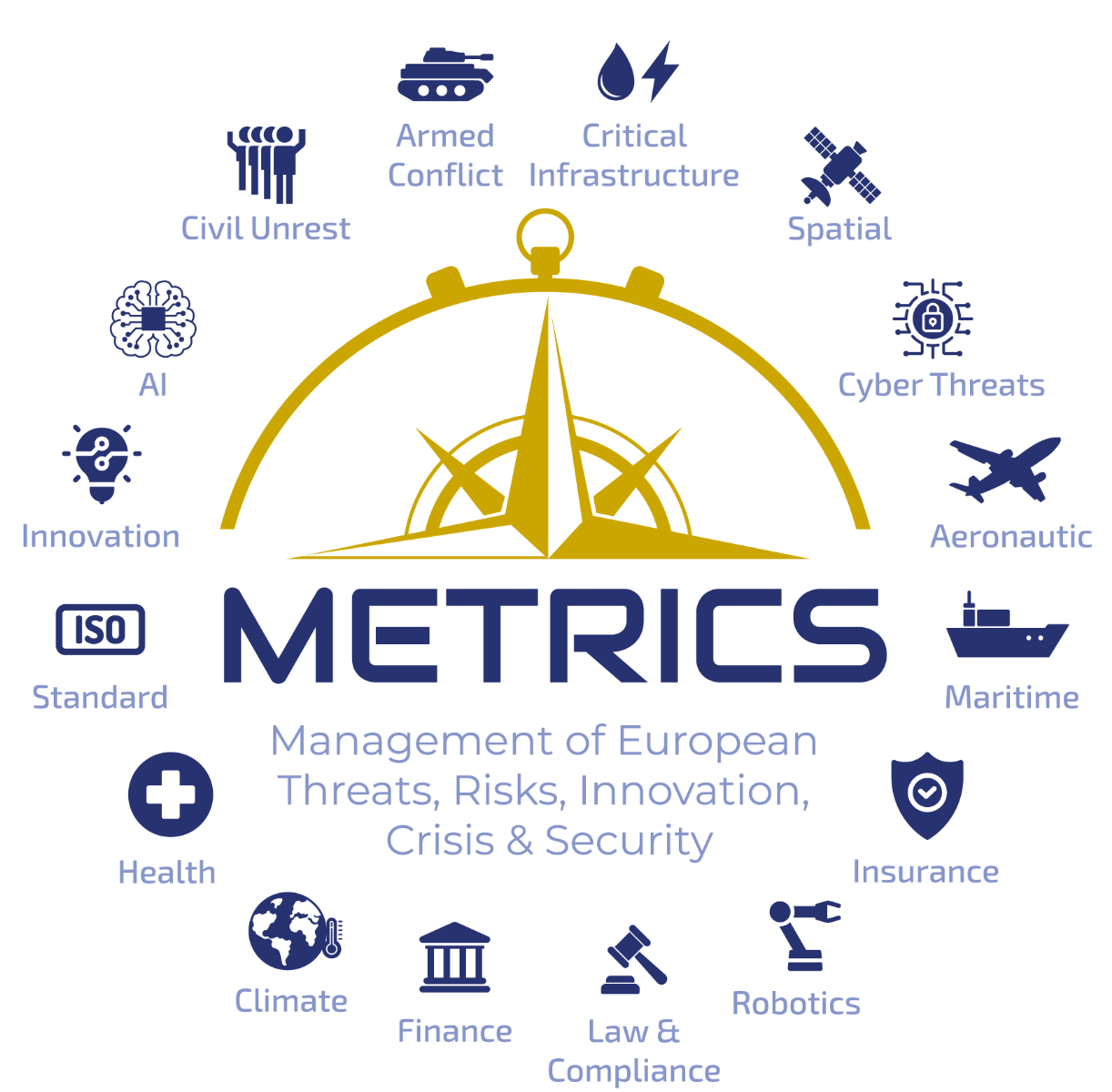
METRICS Summit 2027: bringing experience, science and decision-makers into dialogue
A call to researchers, institutions and experts from Spain, Portugal, Italy and Latin America
Do you work on risk foresight, climate, cybersecurity, civil protection, health, artificial intelligence, critical infrastructure, decision sciences, industrial resilience or crisis governance?
Your research, innovations and operational experience can enrich the European dialogue.
METRICS Summit 2027 invites scientific, institutional and economic stakeholders from Southern Europe and Latin America to express their interest in contributing to the congress’s discussions and round tables.
Scientific and institutional references
- IPCC, Sixth Assessment Report, Chapter 12: Central and South America (2022). Scientific analysis of climate, water, health and food risks. Read the study.
- UNDRR, Global Assessment Report 2025. Assessment of the economic costs of disasters and the investment needed for resilience. The report estimates annual global costs at more than USD 2.3 trillion when indirect and ecosystem effects are included. Read the report.
- European Commission and CELAC, ministerial declaration on research and innovation, 29 September 2025. A particularly relevant document explicitly recognising biregional scientific cooperation as a means of anticipating crises. Read the official declaration.
- European Commission, HERA and the Pan American Health Organization, November 2025. Cooperation on cross-border health emergencies, research and medical supply chains. Read the press release.