Introduction
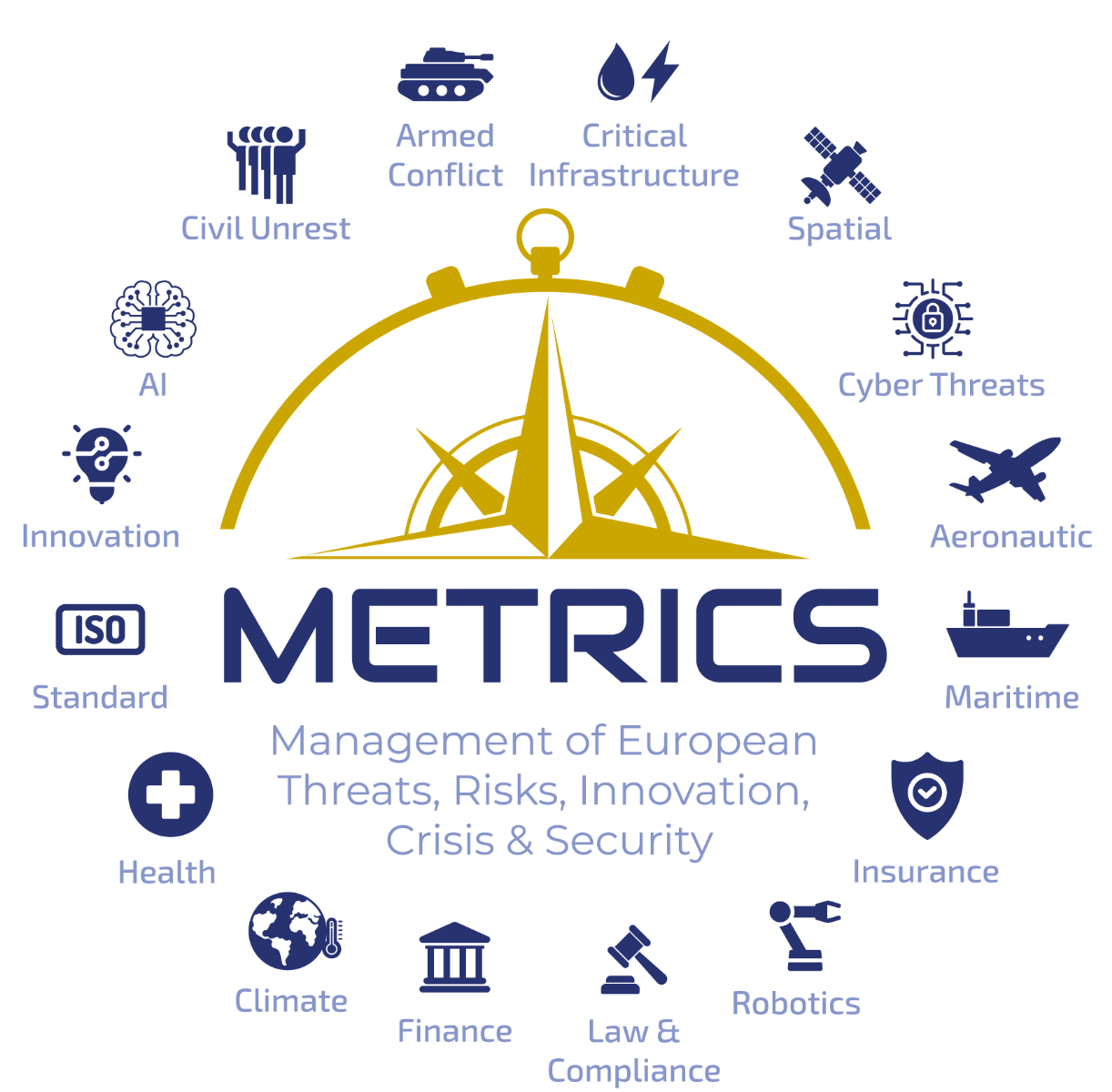
The METRICS congress brings together scientists, public decision-makers, industrial companies, insurers, investors and crisis management specialists to build a shared framework for better forecasting, decisions and recovery.
This project addresses a weakness that is now widely shared. Organisations have numerous methods, data sources and doctrines, but they do not always speak the same language when measuring their actual level of preparedness. The indicators they use often remain fragmented between security, business continuity, cybersecurity, finance, human resources, communication and governance.
From this perspective, ISO 22361 plays an essential role.
Published in 2022, this international standard provides guidelines for planning, establishing, maintaining, evaluating and improving a strategic crisis management capability. It gives a central role to leadership, the quality of decisions, communication, training and organisational learning.
ISO 22361 provides more than a documentation method. It connects governance, human factors, business continuity and lessons learned within a single strategic capability. It therefore offers a common language that can facilitate cooperation between senior management, crisis teams, risk managers, public bodies, insurers and industrial partners.
Several round tables at the METRICS congress address this question.
The round table ‘How much does a crisis really cost? The hidden price of threats, disruptions and inaction’ will explore the economic value of preparedness.
The round table ‘Decision sciences, polycrisis foresight and leadership: making choices under uncertainty and preparing for possible futures’ can examine the command and decision-making mechanisms highlighted by ISO 22361.
The round table ‘Geopolitical foresight, innovation and regulatory power: what scientific and industrial strategy for Europe?’ will place standardisation in the context of sovereignty. The round table ‘Risk science, predictive modelling and insurance innovation: financing and preventing future crises’ will open a debate on measuring resilience, its insurability and its financing.
Finally, discussions on collateral crises, critical infrastructure, supply chains and human resilience will examine the standard in concrete situations of systemic propagation.
ISO 22361 thus appears as a meeting point between decision science, governance, risk economics and operational resilience.
A scientific and systemic approach to crisis
In an environment marked by systemic crises, cyberattacks, industrial disruptions, natural disasters and geopolitical tensions, resilience can no longer be considered simply a security function. It becomes a strategic capability that can influence revenue continuity, asset values, investor confidence and organisations’ ability to obtain financing.
Scientifically, ISO 22361 rests on a systemic understanding of crisis. An organisation is viewed as an interdependent set of human, technological, financial, material and information resources. An initially local disruption can spread between these components and produce disproportionate consequences.
A cyberattack can interrupt production, disrupt logistics flows, affect customer relationships, cause financial losses and engage the liability of executives. A natural disaster can disrupt transport, telecommunications, energy supplies and public services. A health crisis can rapidly become economic, social, political and financial.
A crisis therefore cannot be understood solely through its initial cause. It must be studied as an evolving process marked by interactions, cascading effects, breaking points and propagation delays. The quality of the response depends less on predicting every event than on the collective ability to detect weak signals, interpret incomplete information and decide under deep uncertainty.
ISO 22361 invites organisations to structure this ability around clearly established principles, responsibilities and processes. The standard particularly highlights the role of leadership, the need to prepare teams, the difficulty of making decisions in an unstable environment and the importance of communicating consistently with different stakeholders.
This approach directly reflects METRICS’ scientific ambitions. The congress aims to connect decision sciences, risk modelling, foresight, human factors and analytical technologies to better understand how an organisation moves from a weak signal to an effective decision.
From preparedness to economic performance
Economically, ISO 22361 invites us to treat crisis preparedness as a strategic investment. A prepared organisation does not necessarily remove the probability of a crisis occurring, but it can reduce its duration, propagation and total cost.
This cost is not limited to immediately visible damage. It also includes business interruption losses, service disruptions, recovery expenditure, contractual penalties, litigation, reputational damage, loss of customer confidence and financing difficulties.
These costs may be compounded by longer-lasting consequences, such as the loss of skills, weakening suppliers or a decline in competitive position.
Structured crisis governance can shorten decision times, limit interruptions, preserve cash flows and reduce indirect losses. It can also improve dialogue with insurers, banks, investors and supervisory authorities.
Crisis management capability can be assessed using concrete indicators. We can measure the time required to detect an anomaly, assess an alert, mobilise a crisis team, make a decision and restore an essential function. We can also analyse recovery costs, residual losses, dependence on a critical supplier or the ability to replace unavailable resources.
These indicators allow us to move from declarations about resilience to a measurable approach. They can inform scenario analyses, crisis exercises, insurance models and investment decisions. They can also help compare progress over time without reducing resilience to a single score or a purely accounting-based approach.
The economic challenge is therefore to connect the cost of preparedness with the likely cost of inaction. An organisation can then weigh preventive investments, continuity arrangements, insurance solutions and internal response capabilities.
Leadership, decisions and human factors
A crisis is characterised by a lack of time, incomplete information and strong emotional pressure. Procedures are necessary in this context, but they are not sufficient. The ability to decide also depends on the quality of leadership, clear responsibilities and trust among crisis team members.
ISO 22361 pays particular attention to these human dimensions. It encourages organisations to prepare leaders for dilemmas, conflicting priorities and the sometimes irreversible consequences of certain decisions. It also emphasises the need to safeguard the health and judgement of the teams involved.
This question relates to the work of the METRICS reference framework on behavioural science, leadership, human resilience and decision-making under pressure. Neuroscience, cognitive psychology and simulations help explain decision biases, mental workload, risk perception and collective behaviour in a crisis.
The human factor must therefore not be seen as a weakness external to technical systems. It is a central component of their performance. Decision-support technology creates value only if those responsible understand its limits, interpret information correctly and retain the ability to make choices.
ISO 22361 and the development of the METRICS reference framework
ISO 22361 can provide one of the methodological foundations of the METRICS reference framework. The framework connects international practices with scientific data, economic indicators and the operational realities of different sectors.
The METRICS reference framework aims to assess three essential capabilities: anticipate, decide and rebuild. Anticipating means detecting warning signals, measuring their reliability and determining the time available before a possible disruption. Deciding means assessing an alert, mobilising those responsible, sharing useful information and turning analysis into action. Rebuilding means restoring essential functions, financing the restart and durably reducing the vulnerabilities revealed by the crisis.
ISO 22361 provides a structured vocabulary, recognised principles and a method for continuous improvement. The METRICS reference framework adds comparable indicators, economic models, scientific analyses, simulation exercises and lessons from different sectors.
This connection will make it possible to translate the standard’s principles into measurable questions.
How long does it take to detect a crisis, mobilise responsibilities, decide, communicate and restore essential functions? Which dependencies can trigger a chain reaction? What level of autonomy can an organisation maintain? What is the total cost of an interruption? Are lessons learned from exercises and real crises actually incorporated into future decisions?
Conclusion
The congress examines how the principles of ISO 22361 apply in practice.
The METRICS reference framework aims to compare preparedness, measure decision times and identify critical dependencies. It also helps estimate the total cost of crises and evaluate how well organisations recover.
The METRICS reference framework draws on existing international frameworks, scientific knowledge, economic data and field experience. ISO 22361 can be one of its methodological foundations.
This is where the METRICS manifesto takes on its full meaning. The congress on 7 and 8 July 2027 should be understood as the first milestone in an ongoing effort. Its round tables must bring out shared methods, indicators and priorities, then feed working groups capable of continuing this work beyond the event.
The congress looks at past crises to prepare for future ones. The joint work connects scientific and economic knowledge with the decisions organisations make on the ground.
ISO has a fully legitimate place in this ambition. It can contribute structured language, international experience and proven principles to a European initiative that intends to turn resilience into a measurable, comparable and lasting capability.
The METRICS congress brings standards, science, economics and field experience together to lay the foundations for a shared framework.