East Asia has become a centre of gravity for the global economy and one of the regions where the strategic risks of the coming decades are most concentrated.
China, Japan, South Korea and their regional partners play a decisive role in manufacturing, semiconductors, batteries, artificial intelligence, maritime transport and critical technologies.
Military modernisation, tensions around Taiwan, China’s technological ambitions, questions about US security guarantees and energy vulnerabilities are adding to the uncertainty.
A major crisis in East Asia could reach far beyond the region. Within days it could become an industrial, financial and energy crisis for Europe.
European governments, manufacturers, insurers and investors need to monitor developments, identify vulnerabilities and prepare practical responses before disruptions occur.
1. A strategic region at the centre of global rivalries
Tensions in East Asia converge in the Taiwan Strait, on the Korean Peninsula and around maritime disputes in the East and South China Seas, alongside competition among major powers.
The ASEAN and East Asia summits keep diplomatic channels open among countries whose economies are closely intertwined and whose strategic priorities can diverge sharply.
China is strengthening its technological autonomy, energy security and industrial capacity. Its fifteenth five-year plan, covering 2026–2030, continues that effort to develop and secure strategic sectors.
Japan and South Korea, meanwhile, are strengthening their defence capabilities and deepening international partnerships.
Armed conflict remains avoidable. These developments do, however, point to a lasting shift in the regional balance of power.
The Stockholm International Peace Research Institute (SIPRI) documents rising military expenditure and the modernisation of defence capabilities.
Escalation can start with a misjudgement, an incident or a series of poorly coordinated decisions as readily as with a deliberate decision to go to war.
2. Japan and South Korea: rearmament amid strategic uncertainty
Japan has embarked on a major shift in defence policy. Its national security strategy, adopted in December 2022, aims to raise spending on defence and related security initiatives to around 2% of GDP by fiscal 2027.
South Korea continues to modernise its forces in response to an environment shaped by North Korea’s military and nuclear capabilities.
Both countries are also developing their defence industries and expanding their cyber, space and missile defence capabilities.
Companies including Mitsubishi Heavy Industries, Kawasaki Heavy Industries, Hanwha Aerospace and Hyundai Rotem play important roles in that shift.
For Europe, these developments open opportunities for industrial cooperation. They also make it important to anticipate strain on supplies of electronic components, critical materials and high-tech equipment.
Nuclear deterrence, civilian protection and the resilience of critical infrastructure are also gaining prominence.
Security depends on the equipment a country can field and on its ability to keep essential functions operating through a prolonged crisis.
3. Taiwan and semiconductors: the risk of a global industrial shock
The implications of tension around Taiwan extend well beyond territory and military security.
The island is a major producer of the most advanced semiconductors, which the automotive, aerospace, medical, digital and defence industries rely on.
Taiwan’s TSMC is a critical link in that industry. Its production capacity supplies many international companies, both directly and indirectly.
A Center for Strategic and International Studies (CSIS) study published in June 2025 put the value of goods that passed through the Taiwan Strait in 2022 at roughly $2.45 trillion, more than one fifth of global maritime trade by value.
A crisis around Taiwan could disrupt supplies of electronic components, raise shipping costs, make maritime insurance harder to obtain and halt production at the same time.
Europe experienced some of these vulnerabilities during the Covid-19 pandemic, when shortages of components affected several industries.
European companies including ASML in the Netherlands, Infineon Technologies in Germany and STMicroelectronics in France and Italy occupy strategic positions in this ecosystem.
The practical goal is to reduce excessive concentrations of risk within interconnected global supply chains.
European manufacturers can map critical suppliers, diversify selected production capacity, build targeted strategic stocks and prepare for prolonged disruptions.
Even a company with well-protected factories in Europe can face a shutdown if it runs out of a component made thousands of kilometres away.
4. Energy security: how disruption in the Strait of Hormuz could affect Asian industry
Dependence on energy imports is another major vulnerability for East Asia.
Japan and South Korea import a large share of their energy resources, while China remains heavily exposed to international oil and gas markets.
According to the International Energy Agency (IEA), nearly 20 million barrels of oil a day passed through the Strait of Hormuz in 2025. Most were destined for Asian markets. Japan and South Korea depend especially heavily on supplies that pass through the strait.
Prolonged disruption can drive up energy and industrial costs and put pressure on transport and trade.
Asian energy strategies therefore combine several measures: diversifying suppliers, holding strategic reserves, developing renewable energy and electricity storage, and reconsidering the role of civilian nuclear power.
Mitsubishi Heavy Industries, Hitachi Energy and Doosan Enerbility illustrate some of the industrial capabilities available to strengthen energy infrastructure.
An energy crisis in Asia would also have consequences for Europe. Higher production costs in Asia can feed through to the price of components, industrial equipment and imported goods.
Energy security requires a broader perspective than national supply alone.
A supply disruption in Asia can become an industrial crisis for Europe even when European infrastructure is unaffected.
5. Artificial intelligence, trade and crime: how the risks are changing
Geopolitical tensions account for only part of the challenges facing Asia.
Artificial intelligence, electric mobility, cybercrime, transnational criminal networks and climate disruption are reshaping the region’s economic and security environment.
Competition in AI increasingly centres on access to semiconductors, data centres, energy infrastructure, scientific talent and computing capacity.
The automotive industry is undergoing its own transformation. Electrification is intensifying competition for batteries, rare earths, lithium and storage technologies.
Companies including Toyota, Hyundai Motor Company, Panasonic Energy and Samsung SDI are part of this change.
Transnational organised crime is also a growing challenge for public authorities, financial institutions and businesses. One example is the spread of online fraud networks operating in parts of Southeast Asia.
Climate risks amplify these pressures. El Niño and La Niña can alter rainfall, temperatures and growing conditions, with consequences for prices and logistics.
These risks need to be considered together. A natural disaster can interrupt the production of a critical component, a cyberattack can disrupt transport and an energy crisis can slow several economies at once.
As crises accumulate and interact, their combined impact can outweigh that of any individual event.
6. Preparing for disruption: choices for European businesses and governments
European companies and public authorities need to turn geopolitical monitoring into practical preparations.
Five priorities stand out:
- Map critical dependencies, including suppliers, components, sea routes, raw materials, digital infrastructure and energy networks.
- Plan for disruption, including maritime blockades, major cyberattacks, energy shortages, trade sanctions and natural disasters.
- Strengthen continuity through industrial diversification, strategic stocks, alternatives to critical supplies and crisis exercises.
- Adapt financing and insurance, including cover for political risk, business interruption and maritime transport, and investment in critical infrastructure.
- Deepen international cooperation on research, innovation, economic diplomacy, standards and sharing strategic information.
The European Commission’s work on economic security, the OECD’s research on global value chains and SIPRI’s analysis of military spending can help shape these policies.
SIPRI reports that military expenditure in Asia and Oceania reached $681 billion in 2025, up 8.1% year on year. Japan spent $62.2 billion on defence and South Korea spent $47.8 billion.
These figures show how much attention governments are giving to security. Economic resilience also requires investment in civilian infrastructure, cybersecurity, security of supply and continuity of industrial production.
Trade ties can deter conflict by raising the cost for all sides, although they cannot rule out escalation.
Europe’s resilience also depends on how well it understands crises elsewhere, anticipates their impact and prepares to handle the consequences.
METRICS 2027: preparing for international crises to protect European resilience
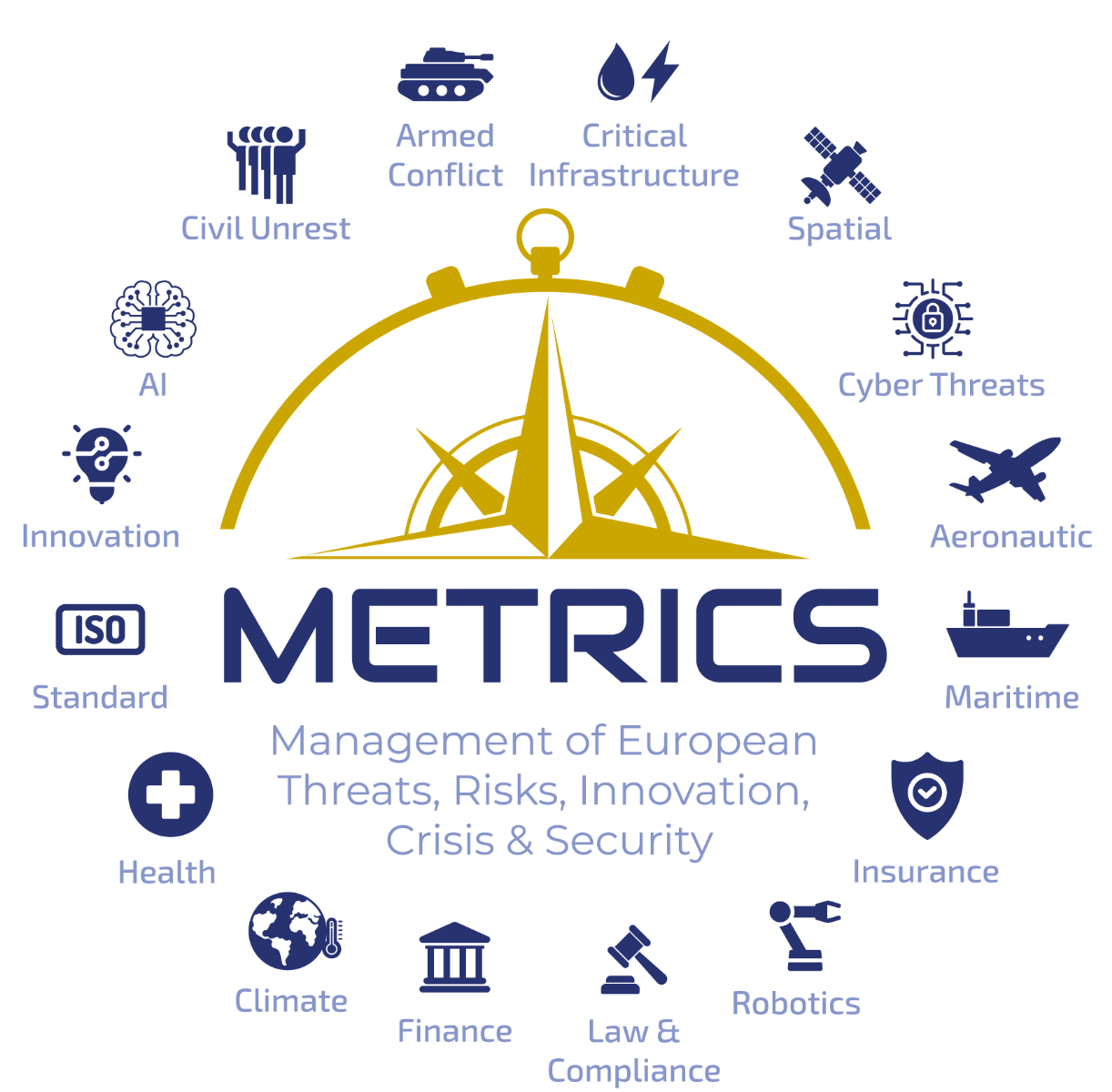
On 7 and 8 July 2027 in Paris, the METRICS European Congress (Management of European Threats, Risks, Innovation, Crisis & Security) brings together institutional, scientific, military, industrial, financial and legal leaders to discuss how to anticipate, manage and recover from crises.
The geopolitical changes in East Asia illustrate the case for connecting defence, economic security, energy, innovation, finance, insurance and the protection of critical infrastructure.
European decision-makers can use these scenarios to understand the consequences of a crisis in Asia and prepare appropriate responses without assuming they can predict it.
Businesses, financial institutions, insurers, researchers and public authorities each have a part to play.
A crisis that begins thousands of kilometres away can weaken a European economy in days. Distance offers little protection when risks are connected.
METRICS European Congress 2027
https://www.metrics-summit.org
Scientific, economic and diplomatic references
- SIPRI (2026), Trends in World Military Expenditure, 2025: https://www.sipri.org/publications/2026/sipri-fact-sheets/trends-world-military-expenditure-2025
- CSIS (2025), Disruptions to Trade in the Taiwan Strait Would Severely Impact China’s Economy: https://www.csis.org/analysis/disruptions-trade-taiwan-strait-would-severely-impact-chinas-economy
- International Energy Agency, Strait of Hormuz: https://www.iea.org/about/oil-securityand-emergency-response/strait-of-hormuz
- European Commission, European Economic Security Strategy: https://commission.europa.eu/strategy-and-policy/priorities-2019-2024/europe-stronger-world/european-economic-security-strategy_en
- OECD, Global Value and Supply Chains: https://www.oecd.org/en/topics/global-value-and-supply-chains.html
- IPCC (2023), Climate Change 2023: Synthesis Report: https://www.ipcc.ch/report/ar6/syr/
- Ministry of Foreign Affairs of Japan, National Security Strategy of Japan (2022): https://www.mofa.go.jp/fp/nsp/page1we_000081.html
The crisis scenarios in this article are planning assumptions. The companies mentioned are examples, and their inclusion implies no partnership with METRICS.