
Due to global challenges and threats, including disruptions in international supply chains, the diversification of freight delivery routes is becoming increasingly critical. Russia’s war of aggression against Ukraine, alongside disruptions, restrictions, and security incidents in the Straits of Hormuz and Bab el-Mandeb (particularly intensifying from 2024 through 2026), have once again underscored the necessity of establishing diverse, multimodal logistical corridors.
When examining the European Union’s primary trade partners, the United States remained the largest destination for goods exported from the EU in 2025 (see Figure 1) with a share of 21.0%. The United Kingdom came second (13.1% of the EU total), followed by Switzerland (8.3%). China was the largest supplier of goods into the EU in 2025 with a share of 22.3%, followed at some distance by the United States (14.1%). China ranks as the EU’s third-largest trading partner for goods and services overall (after the United States and the United Kingdom), and its second-largest trading partner for trade in goods alone (after the United States), with bilateral trade in goods reaching €732 billion in 2024.
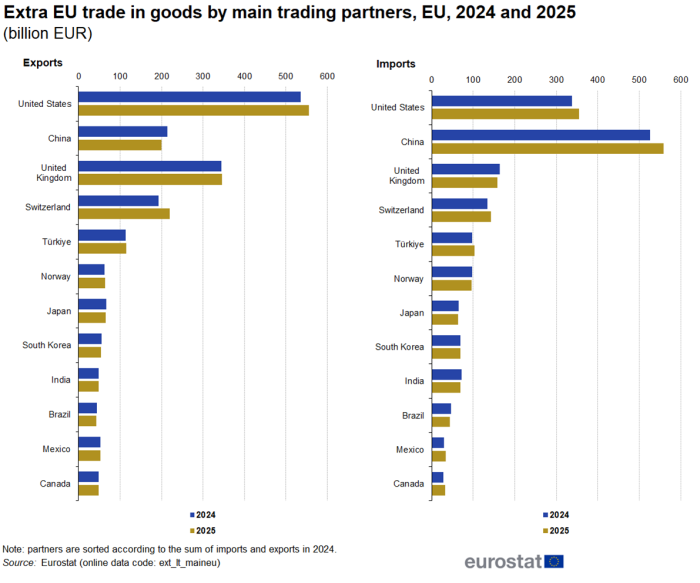
Figure 1. Extra EU trade in goods by main trading partners, EU, 2024 and 2025 (billion EUR). Source: Eurostat (online data code: ext_lt_maineu), reproduced with public statistical authorization.
In times of maritime route insecurity, the strategic importance of overland and multi-modal land-sea routes increases significantly. Analyzing the delivery of goods from China to the EU, Europe and China share an operational requirement for alternative Eurasian connectivity, making the Middle Corridor a viable, albeit complex, solution. Yet this convergence masks profound strategic differences. For Europe, the corridor serves as a vital tool for de-risking and reinforcing strategic autonomy; for China, it represents an extension of westward trade influence. As engagement deepens, Europe faces a delicate balancing act: strengthening regional connectivity without fostering new dependencies or regional entanglements. Achieving this requires sustained diplomatic engagement, rigorous risk mitigation, and a clear articulation of Europe’s long-term strategic priorities across Eurasia.
The Middle Corridor connects China to Europe through Kazakhstan, the Caspian Sea, Azerbaijan, and Georgia, before proceeding via Turkey and onward to European markets. While essential for connectivity, heavy reliance on Turkish transit routes exposes Europe to specific geopolitical vulnerabilities, particularly given that relations between Brussels and Ankara have experienced periodic strains over governance and regional policy alignment. Rather than creating exclusive dependencies, a balanced approach is required.
In this context, integrating Ukraine into the Middle Corridor offers a highly strategic solution for the EU. By routing cargo from Georgia via ferry to Ukrainian ports and subsequently via direct rail to European markets, Ukraine provides a complementary transit vector that broadens Europe’s strategic options, reduces excessive dependency on single transit corridors, and strengthens the overall resilience of the wider transport network. Furthermore, Ukraine shares regulatory proximity and aligned customs procedures as an EU candidate state, ensuring a high degree of transparency and security.
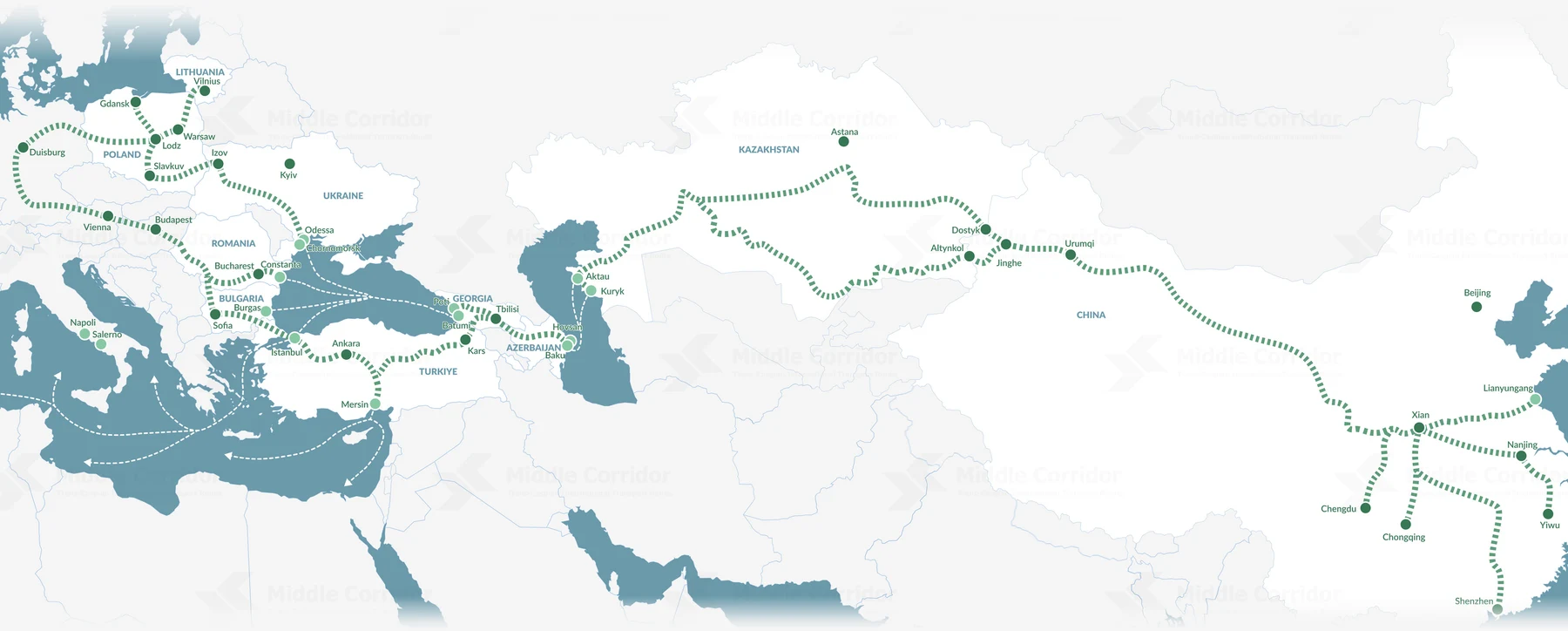
Figure 2. The Trans-Caspian International Transport Route (Middle Corridor). Source: https://middlecorridor.com/, reproduced for academic research purposes.
Additional structural bottlenecks exist along the Middle Corridor, notably within the Zangezur Corridor region between Armenia and Azerbaijan, where regional stability remains delicate despite ongoing peace framework efforts. In the event of localized restrictions or infrastructural blockages in the South Caucasus, Ukrainian Black Sea ports provide a reliable, alternative redirection capacity.
The Middle Corridor traverses Kazakhstan, Caspian Sea ports, Azerbaijan, and Georgia, subsequently offering three primary western branches: via Romania, Turkey, or Ukraine. Given that Middle Corridor branches access the Black Sea basin, Ukraine possesses enormous potential as a high-capacity transit and transshipment hub for goods originating from Central Asia. Consequently, Ukraine’s integration into the Middle Corridor functions as a crucial stabilizer against emerging bottlenecks or crisis scenarios in East-West supply chains.
Ukraine officially joined the “Trans-Caspian International Transport Route” (TITM) association in May 2016. This membership enables active participation in tariff policy formulation, transportation cost optimization, and transit development through Black Sea ports, notably Chornomorsk. Following the disruptions caused by Russia’s war of aggression and the subsequent constraints on traditional northern corridors, TITM has grown critically important for secure Eurasian trade exchanges.
While Ukrainian port logistics currently operate under wartime constraints and face regional competition from neighboring Black Sea facilities in Romania and Bulgaria, Ukraine's long-term infrastructural capacity remains exceptionally strong. Romania, for instance, has successfully served as a primary transit hub during the conflict, expanding highway networks and upgrading the Port of Constanta to handle significant volumes of agricultural and industrial goods within the EU customs boundary. Similarly, Bulgaria is modernizing its port infrastructure in Varna to alleviate transit congestion. Turkey maintains advanced maritime expertise through the Bosphorus Strait chokepoint, though it remains situated near volatile regional zones.
To fully optimize this network, Ukraine offers deep-water capabilities across the Danube river ports and the Odesa port cluster, supported by planned infrastructure modernizations such as Danube Delta dredging and the construction of standard European-gauge railway links connecting Odesa directly to the EU border. Combined with prospective customs integration (“customs visa-free” framework), Odesa and the Danube ports are positioned to transform into the “Eastern Gate of Europe,” mirroring historical western gateways like Antwerp.
Furthermore, these developments foster the emergence of a “Ukrainian meridian” along the Baltic–Black Sea axis (Baltic States — Poland — Ukraine — Turkey — Middle East — South Asia), serving as an intersection point for major Eurasian trade vectors. Historical precedents, such as the dispatch of the pilot container train from Chornomorsk across Georgia, Azerbaijan, and Kazakhstan to China in January 2016, demonstrate the operational feasibility of these alternative pathways bypassing Russian territory.
The European Union has recognized these strategic imperatives by prioritizing Ukraine’s integration into the TEN-T transport network, supported by targeted investments from European institutions and the EBRD to modernize rail, maritime, and road infrastructure along the Solidarity Lanes and reopened Ukrainian maritime corridors.
Conclusion
While active hostilities impose temporary constraints on immediate full-scale utilization, Ukraine’s geographic positioning and institutional alignment provide a structurally robust foundation for European transport resilience. Diversifying away from single-route dependencies and incorporating secure, transparent corridors like the Ukrainian transit vector ensures long-term stability, supply chain security, and strategic autonomy for Europe’s economic future.